

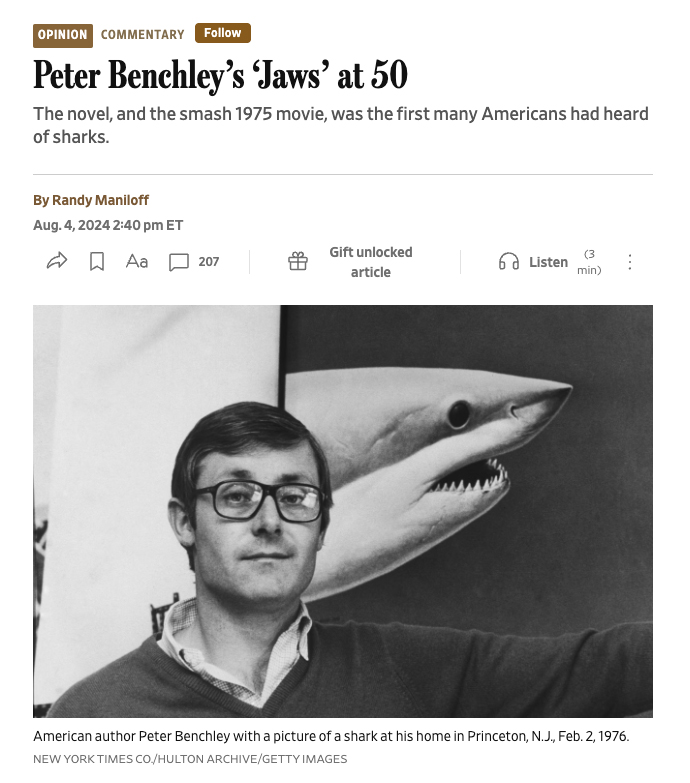
Sharks have trolled the oceans for hundreds of millions of years. But many people have been aware of them only since 1974. That’s when Peter Benchley’s novel “Jaws” arrived on bookshelves.
Benchley died in 2006 at 65. His widow, Wendy, tells me in an interview that the anxiety over sharks her husband’s novel induced was unjustified. People had been swimming in the ocean with sharks for years. They “just didn’t know it.”
The newfound anxiety led to unfortunate consequences. It “gave people the license to kill sharks,” Mrs. Benchley, 83, says, describing in disgust fishermen hanging their shark kills like trophies.
But it “created fascination and excitement, too.” Mrs. Benchley recalls the countless letters her husband received from readers, informing him that they’d decided marine biology was now in their future.
He didn’t intend for the shark to be the central element of “Jaws,” she says. In the introduction of a later edition, the author writes that he “had no interest in writing a one-note horror story: shark eats people.” Instead, Mrs. Benchley says, her husband set out to write a story “about how people cope with a danger that they cannot control.”
A journalist and speechwriter for President Lyndon Johnson, Peter Benchley grew up summering in Nantucket, Mass., a beach town where year-round residents earned most of their income during the tourist-filled hot months. In his novel, Benchley created the analogous Amity, a fictional seaside resort on New York’s Long Island whose population swelled from 1,000 to 10,000 during the summer.
The Amity police chief’s immediate reaction to the first fatal shark attack is to close the beach for a couple of days to give the shark time to leave. But local politicians, worried about the economic impact, argue against such drastic action. The editor of the local paper shares their concern and suppresses news of the first death.
Mrs. Benchley mentions some media stories that compared the plot of “Jaws” to the Covid-19 pandemic—an uncontrolled natural threat, a debate over closing businesses. She says the comparison proves the “staying power” of “Jaws.”
The 1975 movie version is famous for the line “You’re gonna need a bigger boat,” spoken by the shocked police chief when he sees the shark up close for the first time. I ask Mrs. Benchley if her husband regretted not having thought of that. “No,” she says, laughing. “But he certainly admired the line.”
Mr. Maniloff is an attorney at White & Williams LLP in Philadelphia.