
Starting tonight and running three days in a festival setting, with up to 700,000 people, the NFL Draft is a testament to the passion of NFL fans — and to the league’s commitment to satisfying it.
“No one walks away from the draft having won or lost. Everybody thinks [their team] has gotten better,” Peter O’Reilly, the NFL’s top official responsible for the event, tells me in an interview. “Hope is at the center of the draft,” he says.
Since 2015, the NFL has taken the draft on the road and made it a football-palooza for fans to get together and share their hope for the upcoming season. It’s become a defensive tackle size event. But that’s hardly a surprise when 89 of the 100 most-watched programs on television in 2025 were NFL games.
Pittsburgh’s iconic location
“The draft wasn’t broken in New York,” O’Reilly says. He’s referring to the time from 2006 to 2014 when the player selections took place in Radio City Music Hall. It was “really successful” as an event and as a prime-time television show. But the “vibe” that the draft now provides, he explains, “you don’t get inside a theater.”
There is nothing “cookie-cutter” about the production, O’Reilly tells me. For each location, the league asks itself, “How do we do right by that city? How do we shine a big, positive spotlight on that city and on that team?”
That makes the Steelers “the DNA of the draft,” and he points to the organization for helping to “shape what’s relevant and what’s resonant” for the event.
“You [also] need to make sure it reflects the market we’re in and does that in the right ways,” O’Reilly adds. He recounts his first planning conversation with members of the Rooney family. It was about “how do we make sure we celebrate Western Pennsylvania’s deep history and present of football.”
O’Reilly, 53, the league’s executive vice president for Club Business, International & League Events, also oversees the Super Bowl. The 20-year league veteran explains that the draft brings organizational challenges that the annual championship game does not.
“Because it is not in an NFL stadium,” O’Reilly says, the draft “takes a green field approach every time.” The league seeks an “iconic location” to be “the hub of activity,” such as the drafts held on the Rocky steps of the Philadelphia Art Museum in 2017 and on Lower Broadway in Nashville in 2019.
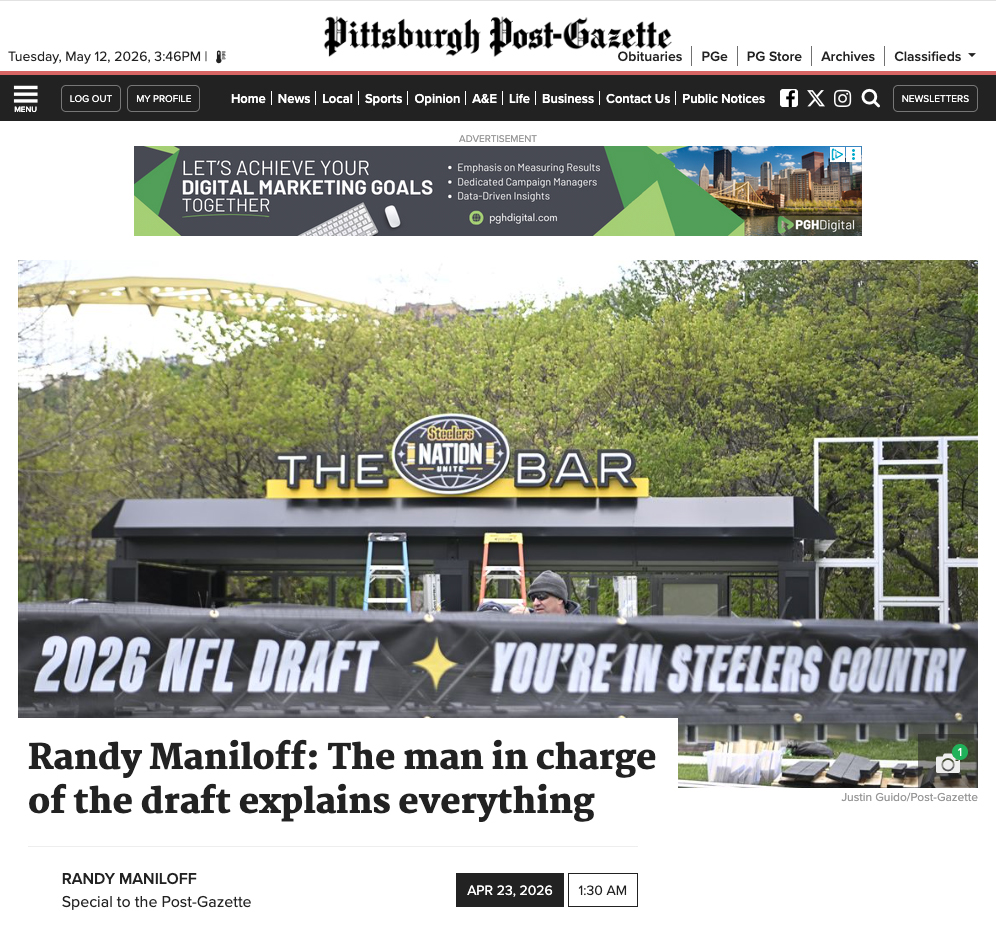
For the Steel City, that iconic location is the confluence of the three rivers. The player selections will be announced from a podium on the stage of the NFL Draft Theater built next to Acrisure Stadium. The free-of-charge NFL Draft Experience will take place on the North Shore and at Point State Park. The Roberto Clemente Bridge, open to foot-traffic only, will connect the venues.
O’Reilly describes the scene and envisions it with “Terrible Towels as far as the eye can see.”
The passionate fans
The draft held two years ago in downtown Detroit stands as the largest, with more than 775,000 attending. But what about the first year, I asked. Were there concerns that fans might not turn out to hear names read from a card?
The inaugural road show draft was held in Chicago with Grant Park as the hub. Some in the league office were nervous, O’Reilly says. Then, the day before the draft, he looked out of his hotel window.
“I saw fans from what looked like every team peering through the fence to see what this draft looks like.” That’s when he knew the event was going to work. He should have known that, he says, “because the NFL fan base is so strong. That’s the passion that exists.”
For that reason, he says, the league wants “the most exciting product out there on the field. That fuels everything. It leads to the type of passion that our fans have.” He added: “When you’ve got fans who care so much, and are so invested in their favorite team, you want to make sure you’re delivering for them.”
Balancing the competition
A competitive balance of the franchises is integral to maintaining the product and the fan fervor. Along with the league’s salary cap, the draft is a big part of creating that equilibrium, by giving the teams with the poorest records the most access to the best college players.
A team’s choices can make or break its next few seasons. The Patriots picked up Tom Brady in the sixth round. A few years later, the Raiders chose another quarterback, JaMarcus Russell first overall, and he washed out of the league three years later after going 7 and 18 as a starter with a horrible passer rating.
“Every team, every year, has real hope,” O’Reilly says. He notes that neither team that played in Super Bowl LX earlier this year — the Seattle Seahawks and New England Patriots — had made the playoffs the previous season.
Through the league’s effort — and with much acknowledgement given to the work by Visit Pittsburgh — the city is about to welcome what O’Reilly calls an “incredible sea of humanity … to hear a name read from a card. That name could be the name that changes their franchise.”
Randy Maniloff is an attorney at White and Williams, LLP, in Philadelphia and an adjunct professor at the Temple University Beasley School of Law, and an occasional contributor to the Post-Gazette.