
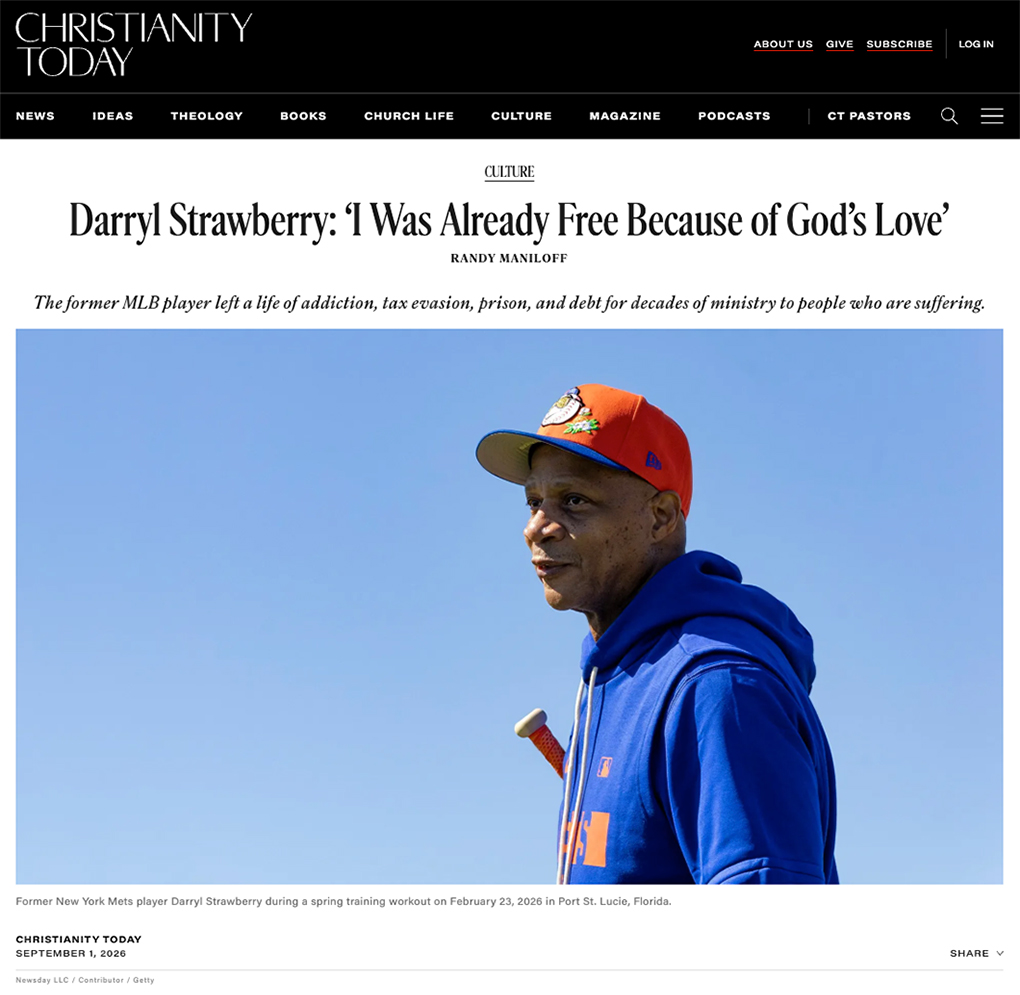
When Darryl Strawberry visited the Louisiana State Penitentiary hospital ward and death row in 2024, he sat on the edge of one frail prisoner’s bed and prayed. When he was finished, the former Major League Baseball player embraced the man and pulled his blankets up over his bony shoulders.
He’s had other moments like this while serving as a Christian minister for more than two decades. God gave him a gift, he says, to give back to people who are suffering. He calls his skills as a baseball player simply a talent.
Those skills were abundant. Over 17 seasons, the 1983 National League rookie of the year hit 335 home runs, played in eight All-Star Games, and was on four World Series champion teams. The New York Mets retired his uniform number, 18, in a pregame ceremony two seasons ago.
But the slugger’s failures away from the field sometimes overshadowed his accomplishments on it. Headlines shouted his drug and alcohol addiction, his guilty plea to tax evasion, his 11 months spent behind bars in Florida for violating probation on a cocaine possession charge. At one point, he was $3 million in debt.
Now, Strawberry’s ministry operates on the road. The 64-year-old says he spends 270 days a year preaching at churches, motivational conferences, schools, prisons, and hospitals, seeking to restore lives and relationships from the root causes of addiction and other life controlling issues.
In an interview over Zoom last month, I asked Strawberry what he hopes to accomplish by visiting inmates in their final hours and others who would never walk free.
He said he goes to let them know it’s not too late to make things right with God. “No matter what you’ve done from an earthly standpoint,” Strawberry said he delivers to them God’s promise that “if you give me your heart, and surrender yourself to me, I will allow you to enter into paradise with me one day when your life is over.”
He points to his own life: “If he saved me, he can save you.”
Strawberry’s salvation was a mother’s prayer answered. After Ruby Strawberry died in 1996, a journal found under her mattress contained prayers for each of her five children. For Darryl, she had asked God to “knock him off of his throne and save him.”
Strawberry says that while his mother was proud of his accomplishments as a ballplayer, she was also painfully aware of his conduct away from the diamond.
“I don’t need his life to be a legacy of just Major League Baseball,” Strawberry says, interpreting his mother’s prayer. “I need you to make sure that he is the man you created.”
When the future major leaguer was 13, his father Henry Strawberry, a postal clerk, came home after midnight in a drunken rage. With a shotgun in hand, he threatened to kill the entire family.
Strawberry’s older brother Michael grabbed a skillet, older brother Ronnie a butcher knife, and Darryl a frying pan. A stand-off across the dining room table ensued.
It was the first time the boys had ever stood up to their physically abusive, alcoholic father. Henry backed down, left, and never returned to the family’s South Central Los Angeles home.
While Darryl Strawberry points to his father as the source of his addiction, he does not blame him, calling that “a clichéd excuse for bad behavior.” Strawberry said he takes “full responsibility for everything I have ever done.”
Many years later, Strawberry received a call that his father had suffered a stroke and the prognosis was not good. Strawberry made the decision not to visit him in the hospital.
“After all the things he’d done to our family,” Strawberry writes in Another Life, his just-published memoir, “the hurt went too deep. I didn’t think I could find the forgiveness.” But when he remembered that God had forgiven his own sins, he went to the hospital—and was shocked by the words coming out of his mouth. He first asked for his father’s forgiveness for keeping him out of his life. The elder Strawberry said yes.
Then Strawberry asked his father if he wanted to experience the same forgiveness. The answer: yes. “The Lord wanted to give [grace] to my father without being concerned with whether he’d earned it or not,” Strawberry writes. “He used me to extend the very grace I’d received.”
“When I left his hospital room, I was free. Truly free for the first time in my life.” Strawberry told me, “No matter how much we want to hold someone else hostage, basically you’re holding yourself hostage.”
As a baseball player, Strawberry had countless statistics to judge his performance. Does he wonder what his batting average is at helping others? When he began ministry, he said, he looked for measuring sticks but God told him, “It’s not about you.”
When I asked Strawberry for some examples of people whose lives his sermons and talks had affected, he gave the same answer. “It’s not about me. … It is the Spirit of God that changes people.”
Strawberry said his task is to just “deliver the message”—but his former life plays an important role in how he does it. He tells of his baseball career and “being lost.” Some of those listening remember seeing him in handcuffs and addicted to drugs, but now they see him standing at a pulpit. He says he got there because “I surrendered my life to God to help me become what he created me to be.”
Strawberry’s wife of 20 years, Tracy, has also helped. She was an addict whom God changed: With an MBA and a doctorate in theology, Tracy is now a minister and business consultant with her own faith-based addiction recovery work. Strawberry jokes that his father-in-law, a lifelong St. Louis Cardinals fan, dropped the phone upon hearing that a “lousy, rotten Met” was coming to live in his house.
Late last year, President Donald Trump, citing Strawberry’s years of ministry work, pardoned him for his tax evasion conviction. Strawberry was a contestant in 2010 on Trump’s Celebrity Apprentice reality show. He said the pardon “was something special [but] wasn’t something I was asking for. … I was already free because of God’s love.”
