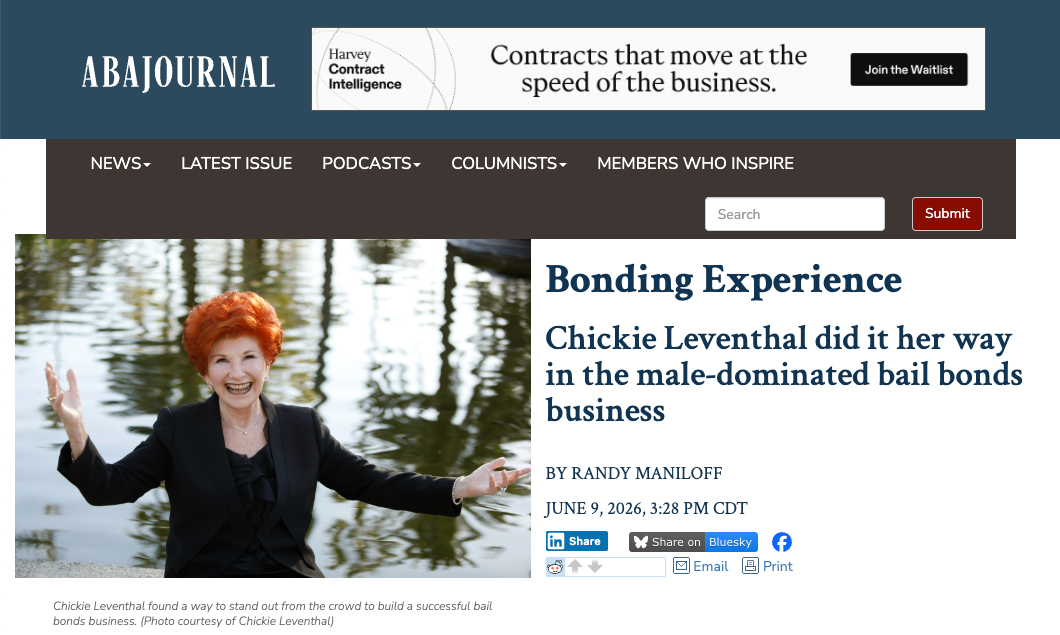
In 2003, famed musical producer Phil Spector was in police custody in Alhambra, California, on suspicion of murder. His attorney, Robert Shapiro, wanted his client released without delay. He sent Chickie Leventhal to post a $1 million bond.
“The most important call I make upon being retained in a criminal case is to Chickie,” Shapiro tells me. “When the stakes are high, speed is the top priority. Chickie will drop everything to serve the needs of her clients.”
Leventhal’s road to having such renowned lawyers calling her to spring their celebrity clients had humble beginnings.
In 1984, Leventhal was 50 years old and facing an uncertain financial future. Her husband, an engineer for the Los Angeles County road department, was battling multiple sclerosis. Over the years, she had worked on and off in the bail bonds industry in a variety of secretarial and supervisory positions. But now that wasn’t going to cut it. She needed a more lucrative role. Leventhal obtained her bail agent license from the state of California, and the newly minted agent hatched Chickie’s Bail Bonds.
With a name like Chickie, she’d surely set herself apart. The nickname (her real name is Sophie) came from her mother, who said her newborn daughter cried like a chicken when she came home from the hospital. So Mom called her “Little Chickie.”
Big hurdles remained in getting Leventhal's name out.
Bail bondsmen typically set up shop near a jail. But Leventhal couldn’t afford an office. She decided she would go to the clients. “Call Chickie—She comes to you!” became her company’s slogan.
Huge Yellow Pages ads were a staple for bail agents. For Leventhal, that was also too expensive. So instead, she would meet with criminal defense attorneys and seek referrals of their clients.
Leventhal had one more trick up her sleeve.
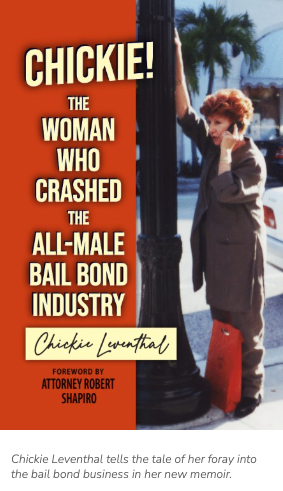
In her recently published memoir, Chickie! The Woman Who Crashed the All-Male Bail Bond Industry, the Chicago native recounts sizing up her competition: Al’s Bail Bonds, Larry’s Bail Bonds, Rick the Bailman, Fast Eddie’s Bail Bonds. “Not one woman in sight,” Leventhal wrote. “I knew in that moment that was how I was going to stand out from the crowd.”
Lawyers were used to bail agents being brusque and unkempt men. Leventhal, at 5’4” on her toes and in a black pantsuit, would sell them on the benefits of a kinder and gentler approach.
“We treated their clients with the utmost respect, dignity and compassion,” Leventhal tells me in a recent interview from her home in Clearwater, Florida. “Attorneys liked that their clients didn’t walk into a bail agent’s office and hear, ‘Yeah, what do you want?’ They found that dealing with a nice, middle-aged Jewish mother was far more advantageous than the rough-and-tumble male bail agents they were accustomed to.”
The first door Leventhal knocked on belonged to Beverly Hills lawyer Jeff Bear. He recalled their meeting, telling me he’d never seen a female bail agent.
“They’re a pretty tough group of people,” Bear says of bondsmen. He agreed that Leventhal made her gender-based case. “She was the kind of person I could have contact my clients and make a good impression.”
Bear provided Leventhal with a list of other lawyers to call. Some told her they did not enjoy working with male bail agents because of their gruff attitude and were willing to give her a try.
Leventhal’s business model proved successful. And she stuck with it, even after money was no longer in short supply.
I express surprise that Leventhal, who was later joined by her son in the business, never had an office other than in her home. “Ridiculous,” she shoots back at the thought. “Why make clients travel to me when I’m there to do a service and I can travel to them? We went to the client’s house, office, Starbucks. We met them anywhere they wanted at any hour of the day or night.”
The closest that Chickie’s Bail Bonds came to an office was Dolores Restaurant near her Santa Monica home. “My barstool had three pay phones nearly in reach. One for outgoing calls, one for incoming and the last one for other customers,” she tells me, recounting the setup.
Another thing that set Leventhal’s business apart was her approach to its inherent risks. If a defendant fails to show up for court, bail is forfeited, leaving the agent on the hook for the entire amount unless they later appear. Agents seek to protect themselves by requiring collateral before issuing the bond. This is often in the form of securing a lien on real estate. In the event the defendant flees, the agent can turn to the collateral to avoid liability for the forfeiture.
In addition, a bail agent is paid a nonrefundable premium in the range of 10% of the amount of the bond.
With the protection from the collateral, I suggest to Leventhal that the business doesn’t seem so risky.
Leventhal explains that there can be a “temptation” for bail agents, wanting to get their hands on a large premium, to issue a bond without adequate collateral. “They’ll say ‘I’ll be able to find him if he disappears.’ And in many cases, they can,” Leventhal tells me. “But not always. And bail bond agents can get into serious trouble.”
“I’ve heard bail agents say, ‘If you’re going to write bail, you’re going to write forfeitures.’ They just write it off as part of the business. I just couldn’t see that,” Leventhal says.
She tells me that she avoided this temptation and took great care in issuing bonds and being certain that they were backed by adequate collateral. Every once in a while—and these were particularly unique situations, Leventhal stresses—she relied on her judgment and experience in lieu of hard assets.
Leventhal’s attorney-referral approach also provided a layer of protection that wouldn’t come from clients walking in off the street. “Many of the lawyers would say things to me like "You don’t have to worry about this one, Chickie,’ or ‘You know, you better watch this one.’ They cared about me the same as I cared about them and their clients.”
But despite her cautiousness, Leventhal was left holding the bag when one defendant took flight after she had posted a $325,000 bond after his arrest on a drug charge. The collateral for the bond—three pieces of real estate—had been posted by a business associate of the accused’s uncle. But unbeknownst to her, fraud committed by the property owners had left it worthless, and Leventhal was responsible for the $225,000 still owed after the bond was forfeited.
It was the only significant forfeiture Chickie’s Bail Bonds suffered, and she takes the loss in stride. “When you think about 37 years writing bail, and to only have one significant loss, it’s really pretty remarkable,” she says.
The bondswoman could have suffered some other sizable losses over the years, but bounty hunters located her clients and returned them to custody. I’m curious how they do it. But Leventhal can’t offer much. “They don’t reveal their secrets any more than a magician,” she tells me.
Leventhal took seriously the importance of showing her appreciation to the attorneys who referred their clients. In her first year in business, it was coffee mugs displaying the company’s logo—a chick bursting out of bent prison bars. This was followed by an ever-growing elaborate annual party. The company’s 30th anniversary celebration occupied a ballroom in the Beverly Wilshire Hotel.
Leventhal, now 92, retired in 2021 and closed her business after nearly four decades. She had tried to sell it but was advised that “Chickie’s Bail Bonds isn’t a business without Chickie.”
Leventhal is more than just a savvy businesswoman. She also has an “innate understanding of the legal process,” Shapiro, who wrote the foreword for Chickie!, tells me. “She lives and breathes the concept of innocent until proven guilty.” The Los Angeles Superior Court Bail Bond Committee, comprised of the county’s judges who preset bail amounts for particular crimes, called on her to speak about bail issues.
The nonagenarian set out to write Chickie! to show a side of the bail bonds industry that differs from its often portrayal in television and movies. “It’s always a man,” Leventhal writes in her eponymous title. “One that’s overweight, unshaven and slovenly with a chewed-up stogie hanging out of his mouth.”
While that was her impetus, she soon realized that her story “could be meaningful to young women and even older women,” she says. “To see that someone who is not a college graduate, who went to work at age 17 as a secretary, could achieve something really important in life merely by setting their sights and doing it. And not saying, ‘Well, I’m 50, it’s too late.’ It’s never too late, and I wanted to get that across to people.”
Chickie’s Bail Bonds was born out of necessity. Necessity also drove her business model. The adage is true. But in Chickie Leventhal’s case, it was the Jewish mother of invention.